01628 436 494
Thames Valley Drones

Drone Roof Survey in Buckinghamshire

Buckinghamshire covers a lot of ground, from the Chiltern Hills in the south, through the Vale of Aylesbury, up to the market towns of the north, and the buildings are just as varied. Thames Valley Drones provides a drone roof survey in Buckinghamshire for property owners, facilities managers, surveyors, and roofing contractors who need accurate photographic evidence of a roof’s condition without the cost and disruption of scaffolding or access equipment. One visit, high-resolution images, delivered the same day.

Get in touch
Drone Roof Survey in Buckinghamshire

What Is a Drone Roof Survey in Buckinghamshire?

A drone roof survey in Buckinghamshire means a CAA-qualified pilot from Thames Valley Drones flies a camera-equipped drone around your building and captures every part of the roof in detail, no scaffolding, no cherry picker, nobody walking on the surface. Thames Valley Drones is an aerial survey company that covers the full county, from Amersham, Beaconsfield, Marlow, and High Wycombe in the south through Aylesbury, Chesham, Wendover, and Princes Risborough in the centre, and up to Buckingham, Olney, and Newport Pagnell in the north.

Buckinghamshire has a particularly wide range of building types, Chilterns flint and timber-framed cottages in conservation areas, older agricultural farmsteads and barns across the Vale of Aylesbury, high-value commuter belt residential in the south, and commercial and logistics premises along the M40 corridor. Whatever the building, a drone roof survey in Buckinghamshire covers it in a single visit without any disruption, with labelled, high-resolution images ready to use the same day they are taken.

The Challenges Buckinghamshire Buildings Present

Buckinghamshire does not have coastal exposure, but it presents its own inspection challenges. In the Chiltern Hills, steeply sloping ground, narrow village lanes, and a concentration of listed and conservation area buildings in flint, brick, and timber framing make conventional access difficult. Clay plain tile and slate roofs in this part of the county are fragile and not safe to walk on, a drone surveys them without making contact with the surface. Across the Vale of Aylesbury, agricultural buildings and farmsteads often cover large roof areas that conventional equipment simply cannot reach.

In the commuter towns of Beaconsfield, Gerrards Cross, and Marlow, pre-purchase inspections and condition surveys on high-value residential properties are a regular requirement. Along the M40 corridor, large flat and low-pitch commercial roofs with single-ply, EPDM, felt, and GRP membranes need systematic inspection without disrupting site operations. A drone handles all of it.We inspect all roof types: felt, single-ply, EPDM, GRP, lead, slate, clay plain tile, concrete tile, and metal standing seam.

The Survey From Start to Finish

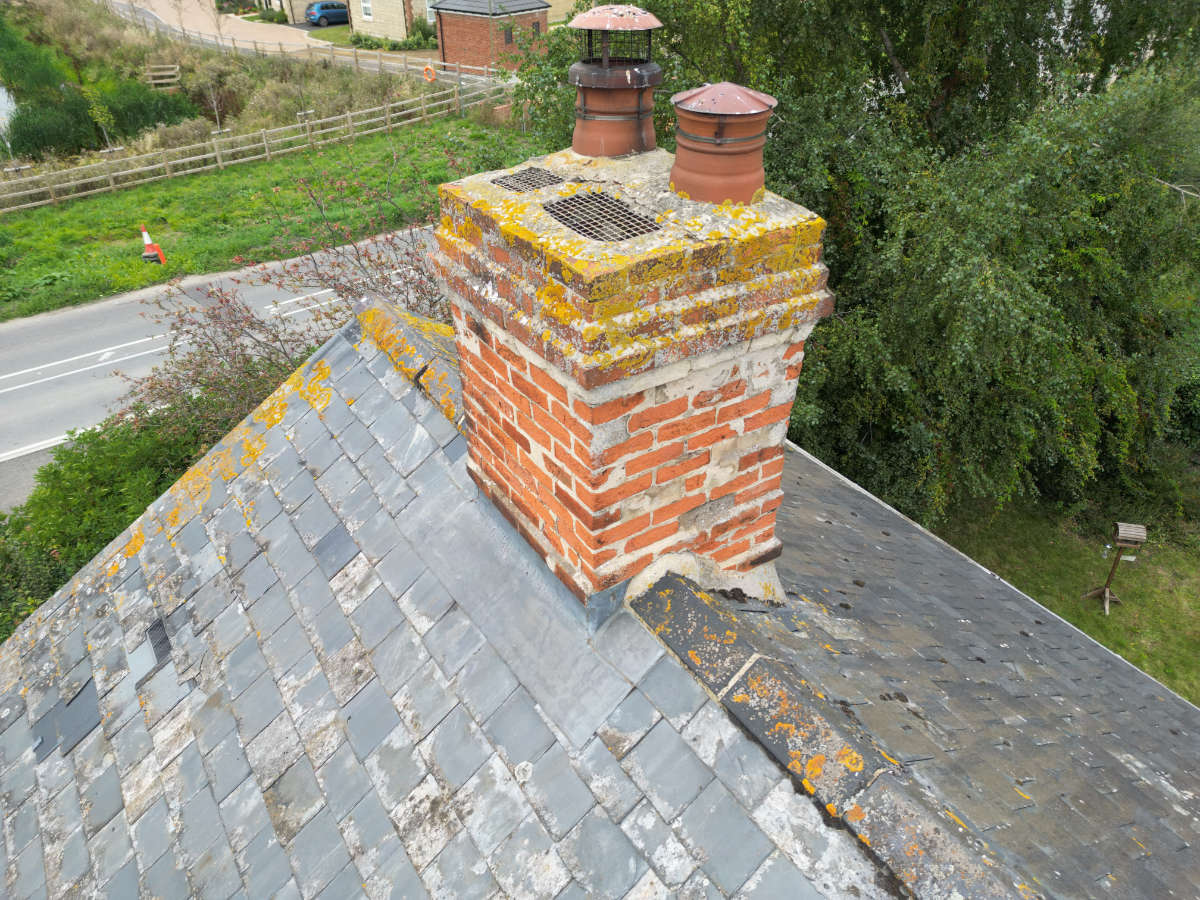
We review the building before arriving on site so the flight is structured rather than improvised. On the day, we work systematically across the roof, flat sections, pitched sections, and any intermediate levels, building up a complete photographic record. Guttering, downpipe heads, and drainage outlets are checked for blockages and deterioration. Flashings, parapet copings, chimney stacks, and upstands are photographed in detail. Any plant, penetrations, or roof-level equipment are included as part of the same flight.

Nothing is skipped because it is awkward to reach. For an older Chilterns building with a complex roofline, a multi-section agricultural building in the Vale, or a large flat-roofed commercial unit near the M40, that thoroughness is exactly what the survey is for. Close passes capture the detail a contractor needs. Wide shots give the overall context. The result is a record that is genuinely useful rather than a set of images that raise more questions than they answer.

Reasons People Get in Touch

The most common trigger is a persistent leak that nobody can pin down from inside the building. Wind-driven rain against older Chilterns properties, particularly those with clay tile, lead, or slate roofs, can expose failing flashings, slipped tiles, and blocked valleys that give no clear indication from inside of where the water is coming from. A drone roof survey in Buckinghamshire gives you a photograph of the probable cause. That is a more useful starting point than working through possibilities with a roofer who has not seen the roof.

Storm damage prompts a significant number of calls. After a notable weather event, roof details that were borderline beforehand, a loose ridge tile, a flashing that was held in place more by habit than by mortar, can fail. Getting photographic evidence of what has actually happened before agreeing repair costs makes sense for owners and insurers alike.

Planned maintenance and routine condition monitoring account for much of the remaining demand. Facilities managers responsible for schools, healthcare buildings, and commercial estates across the county, housing associations with residential stock in Aylesbury and High Wycombe, and property managers overseeing multiple sites all benefit from having a current, dated record of each roof’s condition. A drone survey provides that record quickly and without the logistical overhead of traditional access.

How We Are Qualified to Operate

All pilots hold the CAA A2 Certificate of Competency, the qualification that permits legal drone operations across built-up areas, residential streets, conservation zones, and commercial environments. This covers the full range of settings our Buckinghamshire surveys take place in, from Chilterns village centres with active conservation controls to working industrial sites off the M40. We operate to GVC PDRA-01 standards, carry full public liability insurance, and hold CITB CSCS accreditation for construction site access. A method statement and site-specific risk assessment are completed before every job.

Start Your Drone Roof Survey in Buckinghamshire

A drone roof survey in Buckinghamshire is the most practical way to get accurate photographic evidence of your roof quickly, without disruption, and at a fraction of the cost of traditional access.

Your Images and How They Are Delivered

Images arrive the same day, organised by roof section and labelled so they can be used immediately. There is no processing delay and no need to request delivery separately. A roofer scoping a repair, a surveyor compiling a report, a loss adjuster handling a claim, or a facilities manager updating maintenance records can all pick up the images and work from them straight away.

For commercial clients and larger sites, we can produce marked-up images with a numbered issue key that ties each observation to a specific location on the roof. When findings need to be shared across a team, passed to more than one contractor, or included in a formal report, this removes the ambiguity of handing over an unlabelled folder and expecting people to work out what they are looking at. We keep the flight plan after every survey, so buildings that are inspected regularly can have each successive survey compared directly against the last. Video is available if it suits your purposes better.

Who We Work With in Buckinghamshire

Our clients across the county include surveyors, roofing contractors, facilities and estates managers, property managers, commercial landlords, housing associations, architects, insurers, and loss adjusters. The range of building types in Buckinghamshire means the work is genuinely varied, a pre-purchase inspection on a listed Chilterns farmhouse, a storm damage assessment on a commercial estate in Aylesbury, a maintenance survey on a housing association block in High Wycombe, a condition check on an agricultural building in the Vale. The building changes each time. The process does not.

Several of our clients manage property that extends beyond Buckinghamshire. We cover Berkshire, Essex, Gloucestershire, Hampshire, Kent, Oxfordshire, Surrey, Sussex, and Warwickshire alongside Buckinghamshire, which means clients with multi-county portfolios deal with a single point of contact rather than multiple contractors.

Our Other Services

Alongside drone roof surveys, Thames Valley Drones offers a full range of aerial and ground-based services. These include residential drone roof inspectionsaerial site surveys and inspectionsaerial building inspectionsland surveying and mapping2D mapping and 3D modellingproperty and landscape photographyvideo, and ground, exterior and interior photography. If a single visit to site can cover more than one requirement, we will plan it that way.

Frequently Asked Questions

How much does a drone roof survey in Buckinghamshire cost?

Each job is priced based on the specific building. Get in touch with your details and we will come back with a clear quote.

How long does the survey take on site?

Most single buildings are done within one to two hours. Larger or multi-building sites are scoped in advance so there are no surprises on the day.

Can you survey agricultural buildings and farm outbuildings?

Yes. Farm buildings are well suited to drone surveys, large roof areas, often difficult to access conventionally, and including multiple secondary structures that can all be covered in a single flight.

What about listed buildings and conservation areas?

A drone is frequently the best option for listed and historic buildings because nothing makes contact with the roof surface during the survey. There is no risk of dislodging tiles, disturbing leadwork, or damaging fragile detailing in the process of carrying out the inspection.

Do you cover the whole of Buckinghamshire?

Yes. The full county, including Aylesbury, High Wycombe, Amersham, Chesham, Beaconsfield, Marlow, Princes Risborough, Wendover, Buckingham, Olney, Newport Pagnell, Gerrards Cross, and the surrounding towns and villages throughout Buckinghamshire.

What conditions do you need to fly?

Dry weather, reasonable visibility, and wind within safe operating limits. We check before every visit and reschedule if conditions are not right, we would rather move the job than compromise the quality of the images.